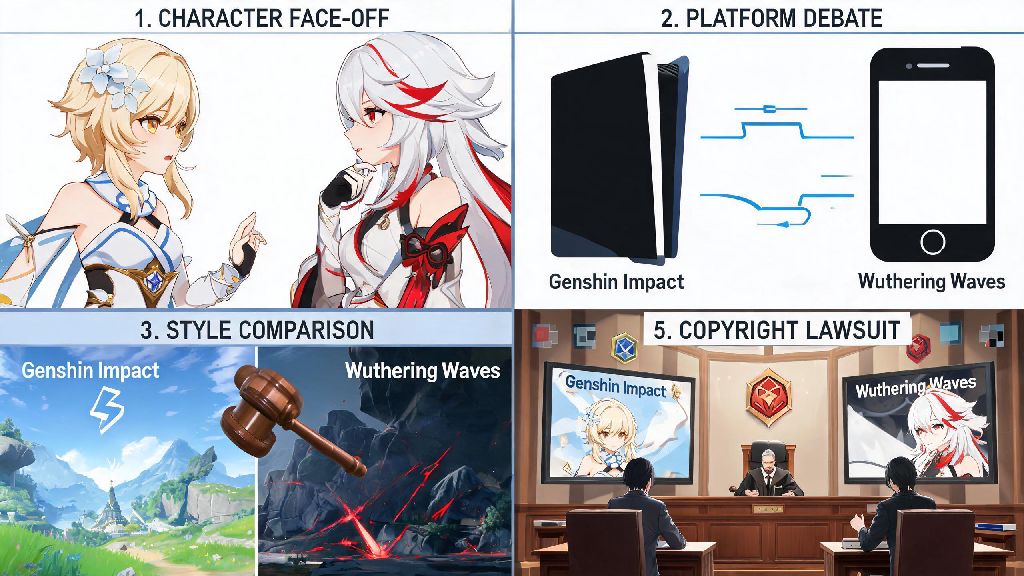
If you’ve spent any time in gacha game communities since Wuthering Waves launched, you’ve almost certainly seen the heated debates popping up in comment sections and social media feeds. Fans on both sides argue nonstop about shared gameplay tropes, design choices, and whether one game is “copying” the other. The core question driving most of these fights is can genshin sue wuthering waves, and the answer is a lot more nuanced than viral social media posts would have you believe. We’re breaking down the actual copyright rules, industry precedent, and real context you need to understand whether a lawsuit is even remotely possible.
Can Genshin Sue Wuthering Waves? Core Copyright Rules for Video Games
First off, it’s important to clarify that anyone can file a lawsuit against anyone else for nearly any reason, but that doesn’t mean the suit will hold up in court. The key factor here is whether HoYoverse, Genshin Impact’s developer, can prove that Wuthering Waves copied protected original creative work, rather than just drawing from shared genre tropes. US and Chinese copyright laws (the two jurisdictions that would apply to any cross-border suit here) both follow the longstanding idea/expression divide.
That means copyright doesn’t protect broad ideas, only the specific original expression of those ideas. For example, the general concept of an open world gacha game with elemental combat is an unprotected idea. But a specific character’s exact 3D model, original soundtrack, verbatim story dialogue, or unique UI design that’s copied pixel for pixel is protected by copyright. Fandom debates about "copying" almost always mix up generic genre tropes with actual protected creative work, which is why so many of these arguments go nowhere.
It’s also not enough for two games to feel similar to casual players. Courts require proof that specific, original elements were copied directly, not just that two games fall into the same genre and share common design features. Most of the similarities people point to between Genshin and Wuthering Waves fall firmly into the unprotected “idea” category, not the protected “expression” category.
What Perceived Similarities Do Fans Point To?
Most of the comparisons fans draw between the two games boil down to standard features of the open world gacha genre that have existed for years, even before Genshin Impact launched in 2020. Many of these features are so common across the genre that they’re considered basic design expectations for new releases. The most frequently cited similarities include:
It’s also worth noting that Wuthering Waves has plenty of unique features that set it apart from Genshin, including a fast-paced parry combat system, grappling hook traversal, and a darker post-apocalyptic story setting. I’ve put hundreds of hours into both games, and the moment-to-moment gameplay feels completely distinct once you get past the surface level genre trappings. None of these individual shared features are protected by copyright on their own, so HoYoverse can’t claim ownership of the entire concept of an open world elemental gacha game.
Past Legal Precedent for Gacha Game Lawsuits
To get a sense of how a potential suit would play out, you only have to look at past legal cases involving gacha and open world games. HoYoverse has filed suit against knockoff games in the past, and they’ve only won when the other game copied exact, specific assets from Genshin Impact. For example, in 2022, they successfully got a mobile knockoff called “Genesis Fantasy” removed from app stores because it used exact copies of Genshin’s character art, UI, and even character names.
But when it comes to games that just share similar genre tropes, courts almost always side with the defendant. A few years back, a group of players sued Epic Games claiming Fortnite copied PUBG’s battle royale format, and the suit was thrown out almost immediately because the core battle royale concept is an unprotected idea. Courts almost always side with the defendant in cases where only genre conventions are shared, not exact copied assets.
I’ve covered gacha industry news for over five years, and I’ve seen dozens of similar debates pop up every time a new high-profile open world gacha launches. 99% of the time, no lawsuit ever materializes, because the legal costs of a multi-year cross-border suit far outweigh any potential gain, especially if the similarities are only surface level. Bad PR from suing a competitor can also hurt a company’s brand way more than any small loss of players to a new game.
What Would Actually Need to Happen for a Lawsuit to Move Forward?
For HoYoverse to even consider filing a suit against Wuthering Waves’ developer Kuro Games, they’d need to have concrete, undeniable proof of direct copyright infringement. That means they’d have to find specific protected assets that were copied directly from Genshin Impact, not just similar design choices. For example, if a Wuthering Waves character’s 3D model was built using stolen Genshin character meshes, or if parts of Genshin’s original soundtrack were ripped and used in Wuthering Waves without permission, that would be grounds for a suit.
Even if they found that proof, they’d also have to prove that those copied elements are a substantial part of Genshin’s original creative work, and that the copying caused measurable financial harm to HoYoverse. Most game companies only file suit over clear, undeniable infringement, not generic genre similarities, because the risk of losing the suit and wasting millions in legal fees is too high.
So far, no one has found any proof of direct asset copying between the two games. All the similarities people point to are standard genre tropes, and both games have entirely original characters, stories, world designs, and combat animations. Even if some fans feel like the games are similar, that’s not enough to win a copyright suit. HoYoverse is also currently focused on expanding its own game lineup with new releases like Zenless Zone Zero, so it’s unlikely they’d divert resources to a frivolous lawsuit against a competitor.
At the end of the day, the answer to can genshin sue wuthering waves is technically yes, HoYoverse could file a lawsuit if they wanted to, but it’s extremely unlikely that they would win unless they have concrete proof of direct, substantial copying of protected assets. Most of the debate online is just standard fandom drama, not based on actual copyright law or industry reality. You don’t have to pick one game over the other, either: there’s plenty of room in the gacha space for multiple high-quality open world games, and competition between developers just means better content and more features for players down the line.